

Denes Schreiner
6 min
Introduction
For national volleyball federations, talent identification (TID) is an expensive logistical bottleneck. Traditional scouting processes are heavily localized, susceptible to human subjectivity, and financially restricted by the costs of clinical motion capture laboratories.
As the FIVB accelerates its Strategic Vision 2032 — headlined by the rollout of the International Centres of Excellence (ICoE) network — the global high-performance landscape is undergoing a massive shift toward objective, data-driven long-term athlete development (LTAD). Recent sports science data indicates that elite junior selection models are transitioning from an obsession with raw height to a Normalized Talent Index Score: a multi-dimensional matrix built on a 60% technical precision and 40% physical biomechanical efficiency split.
To remain internationally competitive, national bodies must implement scalable, decentralized testing protocols. This article explores how markerless mobile computer vision resolves the central dilemma between scientific accuracy and national scale, allowing federations to automate physical profiling across all regional pathways using existing mobile devices.
The Tall Man Bias: Why Raw Anthropometrics Are Insufficient
For decades, volleyball scouting relied on a simple baseline: find the tallest athletes in the school system and teach them the technical aspects of the sport. While skeletal structure and arm span remain non-negotiable biological prerequisites in elite net play, selecting athletes based on stature alone creates an institutional blind spot.
Traditional scouting methods introduce three severe systemic flaws:
- Relative Age Effect (RAE): Scouts consistently select youth players born in the first quarter of the selection year. These players appear more “talented” simply because they possess an extra 9 to 12 months of biological maturity, skeletal growth, and neuromuscular coordination over their peers.
- Subjective Kinetic Evaluation: A scout sitting in a bleacher cannot calculate rate of force development (RFD), joint-loading asymmetries, or eccentric knee flexion speed during a countermovement jump. They rely on “the eye test.”
- Geographical Isolation: Talent distribution is vast, but federation budgets are finite. Promising athletes in rural or minor regional districts are frequently missed because sending high-performance coaches out with traditional laboratory equipment (such as force plates and multi-camera optoelectronic tracking rigs) is logistically impossible.
The New Standard: Multi-Dimensional, Longitudinal Tracking
Modern sports science data confirms that explosive power, reactive agility, and biomechanical movement quality are much stronger predictors of long-term elite transition than height alone. Longitudinal data from world-class youth systems — such as Poland’s National Volleyball Development Program (NVDP) and Italy’s “Club Italia” pipeline — show that long-term success is determined by how efficiently an athlete manipulates their center of mass through the kinematic chain.
To build an unbiased, nationally scalable pipeline, federations require continuous monitoring across specific, mandatory biomotor and kinetic variables:
| High-Performance Variable | Traditional Measurement Bottleneck | Nextletic Automated Mobile CV Solution |
|---|---|---|
| Spike & Block Reach Apex | Requires manual Vertec devices, leading to human recording errors across decentralized camps. | Instant vertical displacement tracking via standard video, validating the exact apex of the jump. |
| Countermovement Jump (CMJ) Phase Depths | Restricted to centralized high-performance hubs equipped with expensive force plates. | Automatically extracts joint angles, eccentric deceleration velocity, and concentric push-off straight from video. |
| Eccentric Landing Asymmetries | Impossible to catch visually at game-speed; results in high rates of patellar tendinopathy. | Tracks bilateral knee flexion angles during the deceleration phase to flag high-risk loading imbalances. |
How Nextletic Decentralizes Laboratory-Grade Analytics
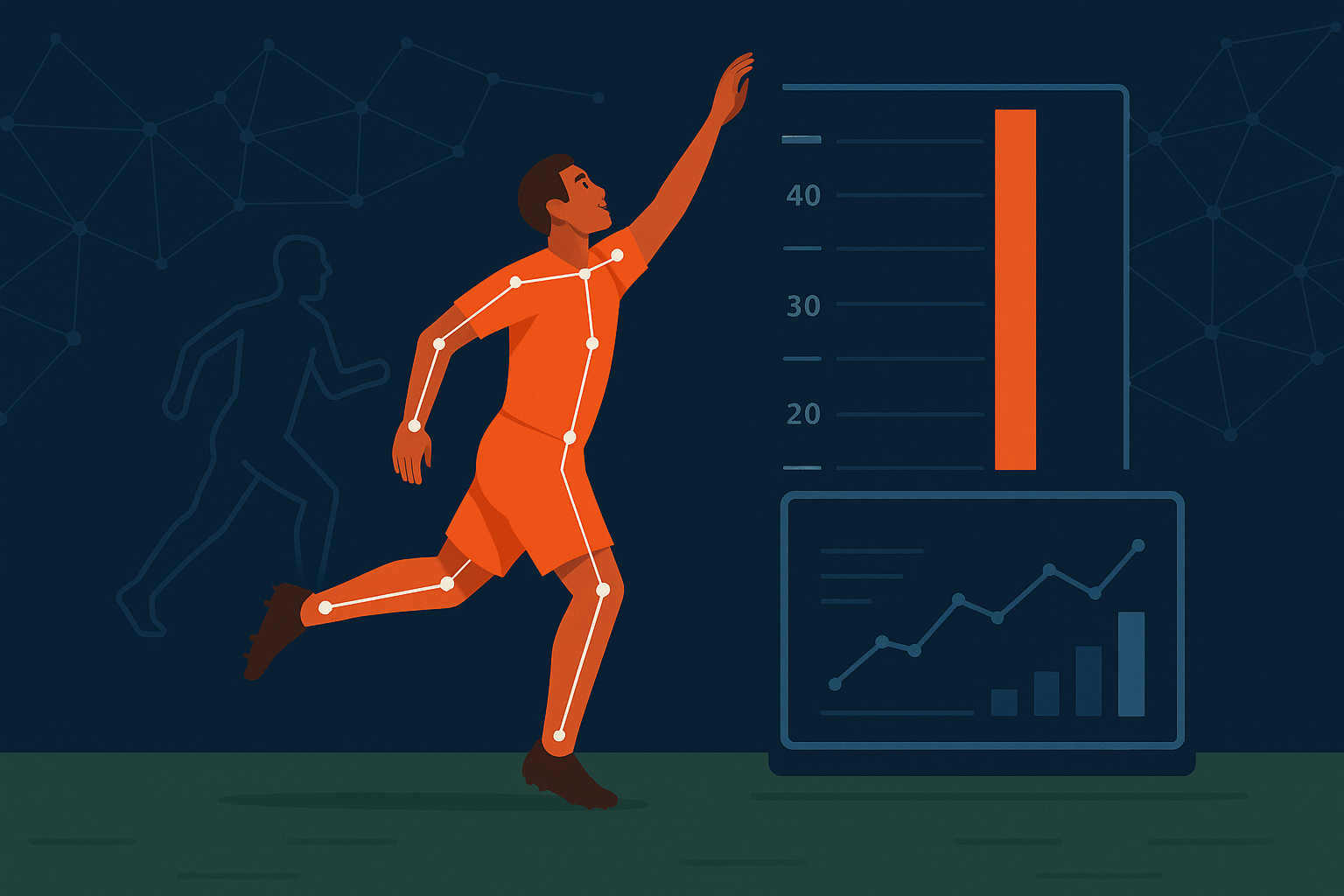
Nextletic bridges the gap between high-level scientific accuracy and grassroots logistical reality. By wrapping advanced pose estimation and markerless computer vision into an intuitive mobile interface, Nextletic transforms any standard iPad or iPhone on a tripod into a full-scale sports science laboratory.
1. Data Capture (Regional School / Club Gym)
- Input Method: Standard iPad or iPhone video capture.
- Protocol: Markerless movement recording on the court.
↓
2. Automated Edge Processing (Nextletic Computer Vision)
- Action: Automated extraction of coordinate data from major joint centers.
- Output: Biomechanical metrics, jump velocity curves, and reach apex verification.
↓
3. Architectural Sync (Central Cloud Data Backend)
- Storage: Secure, structured data storage within the central Lakehouse pipeline.
- Integration: Standardized JSON files synced instantly to the National Registry.
Instead of bringing athletes to a centralized laboratory, Nextletic brings the laboratory to the athlete. A physical education teacher in a rural school or a local club coach records a young prospect performing a standardized testing protocol: a countermovement jump, an Illinois agility run, and a standard spike approach.
The Nextletic software automatically processes the video frame-by-frame, extracting precise coordinate data of the major joint centers. The coach does not manually log metrics, fill out paper screening sheets, or upload messy Excel forms. The application structures the physical movement data into clean, objective metrics, pouring it directly into the federation’s central Lakehouse data architecture.
Institutional Benefits: Data Sovereignty and Asset Protection
Implementing a centralized, mobile-first motion analysis framework delivers direct administrative and strategic returns for federal executive boards:
- Standardization of National Training Protocols: Whether an athlete is tested in the capital city or a remote state hub, the measurement criteria remain identical. Nextletic acts as the digital protocol enforcer, eliminating human testing bias and ensuring data integrity across the entire national pipeline.
- Early Intervention and Injury Mitigation: High-volume jumping sports create massive eccentric loads on young joints. By tracking longitudinal movement mechanics as an athlete goes through early growth bursts, high-performance directors can catch micro-asymmetries and landing flaws before they manifest as catastrophic patellar or shoulder injuries.
- Strategic Allocation of Funds: Under international development programs, federations must justify project support through clear performance tracking and reporting. Nextletic provides unarguable, empirical data showing the precise growth curves and physical readiness of the national youth pool, optimizing resource allocation.
Conclusion: Building the Foundation for 2028 and Beyond
Subjective scouting belongs to a previous era of athletic development. The national federations that dominate the upcoming Olympic cycles will be those that treat athletic movement as structured, measurable data from the very beginning of their development pipeline.
By removing the financial and logistical barriers to elite sports science, Nextletic enables national governing bodies to monitor their entire athletic population continuously. The result is a highly transparent, incredibly accurate, and completely unbiased talent identification framework engineered to build tomorrow’s champions.
Transform Your National Pathway
Is your high-performance department ready to standardize its youth tracking database? Contact Nextletic’s institutional enterprise team today to schedule a technical demonstration of our mobile computer vision pipeline and secure data architecture.
Related Articles
Democratizing Sports Analytics: How Everyday Volleyball Academies Can Finally Measure What Matters
Advanced sports science used to be an exclusive luxury for elite Olympic pipelines. Now mobile computer vision makes regular, actionable movement tracking affordable and accessible for every local club.

The Data-Driven Athlete: How Regular Mobile Biomechanical Testing Unlocks Hidden Potential
Continuous, scalable movement tracking exposes hidden physical talent, corrects dangerous technique flaws early, and shifts player psychology toward an objective, high-performance mindset.

Welcome to the Nextletic Blog
Discover how Nextletic is transforming athlete development through AI-powered analytics, standardized measurement, and data-driven insights for federations, clubs, and coaches.